
SoilTribes CoP 8th Meet-Up: Connecting Knowledge to Reduce Soil Pollution and Support Restoration
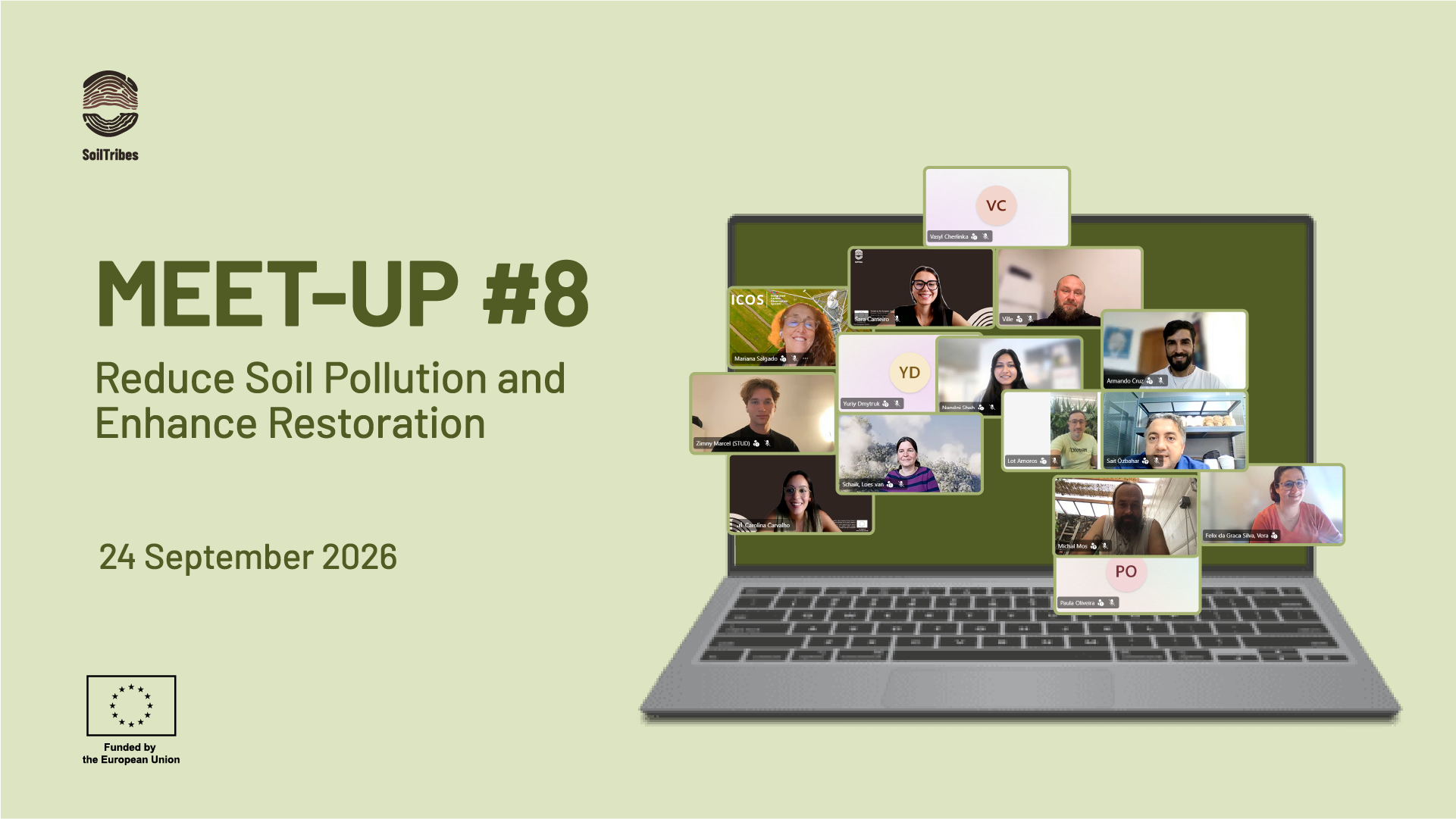
On 24 September 2026, the SoilTribes Community of Practice came together online for its 8th Meet-Up, “Reduce Soil Pollution and Enhance Restoration.” The session brought together 29 participants for an exchange connecting scientific evidence on pesticide pollution with data-driven approaches that can support land-management decisions.
Through expert presentations, joint reflection and open discussion, the Meet-Up created a space to explore soil pollution from different perspectives and consider how research, technology and community exchange can contribute to healthier and more resilient soils.
Understanding pesticide pollution beyond individual fields
The first presentation was delivered by Vera Felix da Graça Silva from Wageningen University & Research, who explored the connectivity, consequences and governance of pesticide pollution.
The discussion highlighted pesticide contamination as a significant soil-degradation challenge that cannot be understood only at the level of individual fields or practices. Pesticides can connect with wider environmental and governance challenges, reinforcing the importance of looking at soil health through a broader and more integrated perspective.
The presentation also emphasized the value of meaningful monitoring and stronger connections between research, policy and practice. Understanding where pollution occurs, how it affects soils and ecosystems, and how evidence can inform decisions is essential to supporting efforts to reduce reliance on harmful inputs.
Making environmental data more accessible with SoilSense
The second part of the Meet-Up introduced SoilSense, a service developed through SoilTribes and IRISCC.
SoilSense works to make Earth Observation and weather data more accessible and usable for landowners and farmers. By helping users interpret publicly available environmental information, the service demonstrates how technology and data can contribute to more informed land-management decisions.
Together, the two presentations connected scientific evidence, monitoring, technology and land management, illustrating the value of approaching soil challenges through multiple perspectives.
The conversations focused on the broader challenge of reducing soil pollution and enhancing restoration, while considering how scientific knowledge, innovative tools and collaboration can reinforce one another.
The session concluded with a recap of key lessons and opportunities for participants to remain engaged with the SoilTribes Community of Practice.
By creating spaces where science, technology and community knowledge meet, SoilTribes continues to strengthen connections between soil knowledge and action.

