
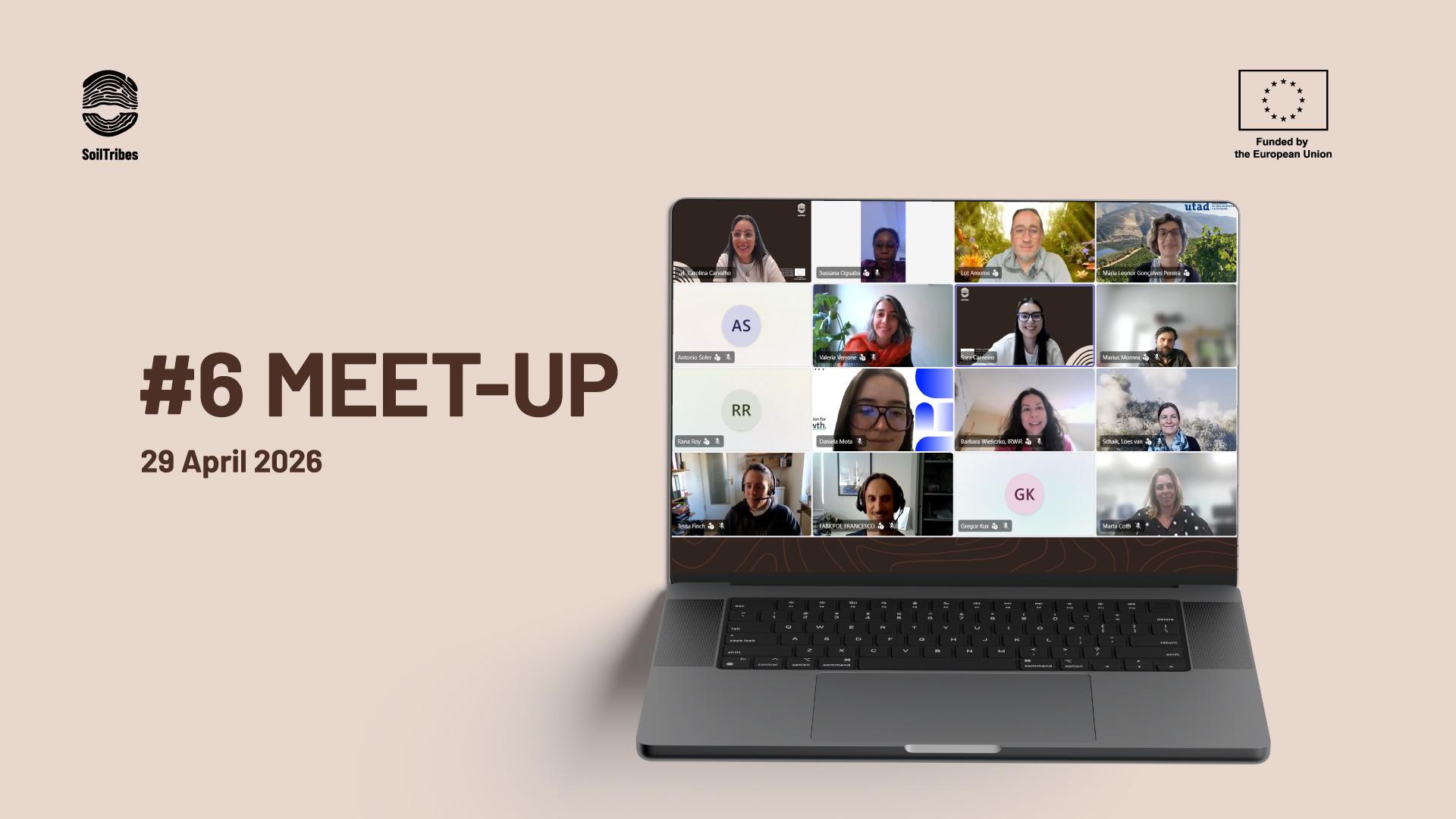
SoilTribes 6th Meet-Up Explored Soil Health, Food Quality and Climate Resilience
On 29 April 2026, the SoilTribes Community of Practice gathered online for its 6th Meet-Up, bringing together around 30 CoP members and members of the public for a shared conversation on soil health, food quality, and climate resilience.
The session created space for knowledge exchange, practical reflection, and cross-sector dialogue. From working directly with farmers to creative approaches using art, drones, and technology, the meet-up highlighted one clear message: restoring soil requires science, creativity, local knowledge, and long-term collaboration.
The 6th Meet-Up offered participants the opportunity to explore how soil restoration can become more practical, accessible, and rooted in real community needs.
Supporting soil health through Living Labs
The first presentation was delivered by Maria Leonor Gonçalves Pereira, Living Lab Leader in the LivingSoiLL project, coordinated by the University of Trás-os-Montes and Alto Douro.
Her presentation introduced the LivingSoiLL project and its work to support healthier soils in permanent crops through a Living Lab approach.
A central focus of the presentation was the Luso-Galician Living Lab, a cross-border initiative between Northern Portugal and Galicia, Spain. Maria Leonor emphasized that the project works directly with farmers from the beginning. Instead of applying top-down solutions, the Living Lab follows a participatory process: listening to farmers, visiting the fields, identifying perceived soil threats, collecting soil samples, analyzing results, discussing the findings with each farmer, and co-creating site-specific solutions.
This approach reflects an important principle for soil restoration: solutions need to be grounded in real field conditions.
Real-life conditions, real soil challenges
The discussion also showed that soil restoration is not a linear process. Working with farmers and living ecosystems means adapting to climate, land conditions, available resources, and local realities.
In the Luso-Galician Living Lab, some solutions include using compost produced by farmers, tailored cover-crop mixtures, and drainage systems to improve soil structure, fertility, and resilience.
This opened an important conversation on the long-term sustainability of soil management practices. Participants reflected on the need to support farmers during the transition to more regenerative approaches, especially small farmers, who may face limited financial resources, aging rural populations, and uncertainty about yields.
Can art and technology restore the soil?
The second presentation was delivered by Lot Amoros, a SoilTribes Community of Practice member from Spain with a background in computer engineering, art, nature, and technology.
His presentation explored the question: Can art and technology restore the soil?
Lot Amoros shared how his work connects technology with ecological restoration, including early experiments using drones to sow seeds, seed coating machines, and artistic installations designed to create empathy with underground life. His approach showed how creativity can open new ways of understanding and interacting with soil.
Through his work, Lot presented technology not as a replacement for ecological knowledge, but as a tool that can support restoration when connected to science, local needs, and practical action.
He also introduced the Green Barriers initiative, developed through SoilTribes support, which focuses on degraded and abandoned land. The initiative seeks to connect people who want to act for nature with scientific knowledge, practical tools, and opportunities for restoration.
Changing mindsets, supporting farmers, building trust
The open discussion brought forward one of the strongest themes of the meet-up: technical solutions alone are not enough. Soil restoration also depends on mindset change, trust, governance, and economic viability.
Participants discussed how farmers need to see practical results in nearby fields, not only scientific papers or theoretical recommendations. Demonstration sites, peer learning, and field-based evidence can help make sustainable soil practices more understandable and more trusted.
A Community of Practice rooted in action
The 6th SoilTribes Meet-Up demonstrated the value of bringing different perspectives together. Scientists, farmers, technologists, artists, community actors, and project representatives contributed to a shared conversation on how to protect and restore soil in ways that are practical, creative, and socially relevant.

